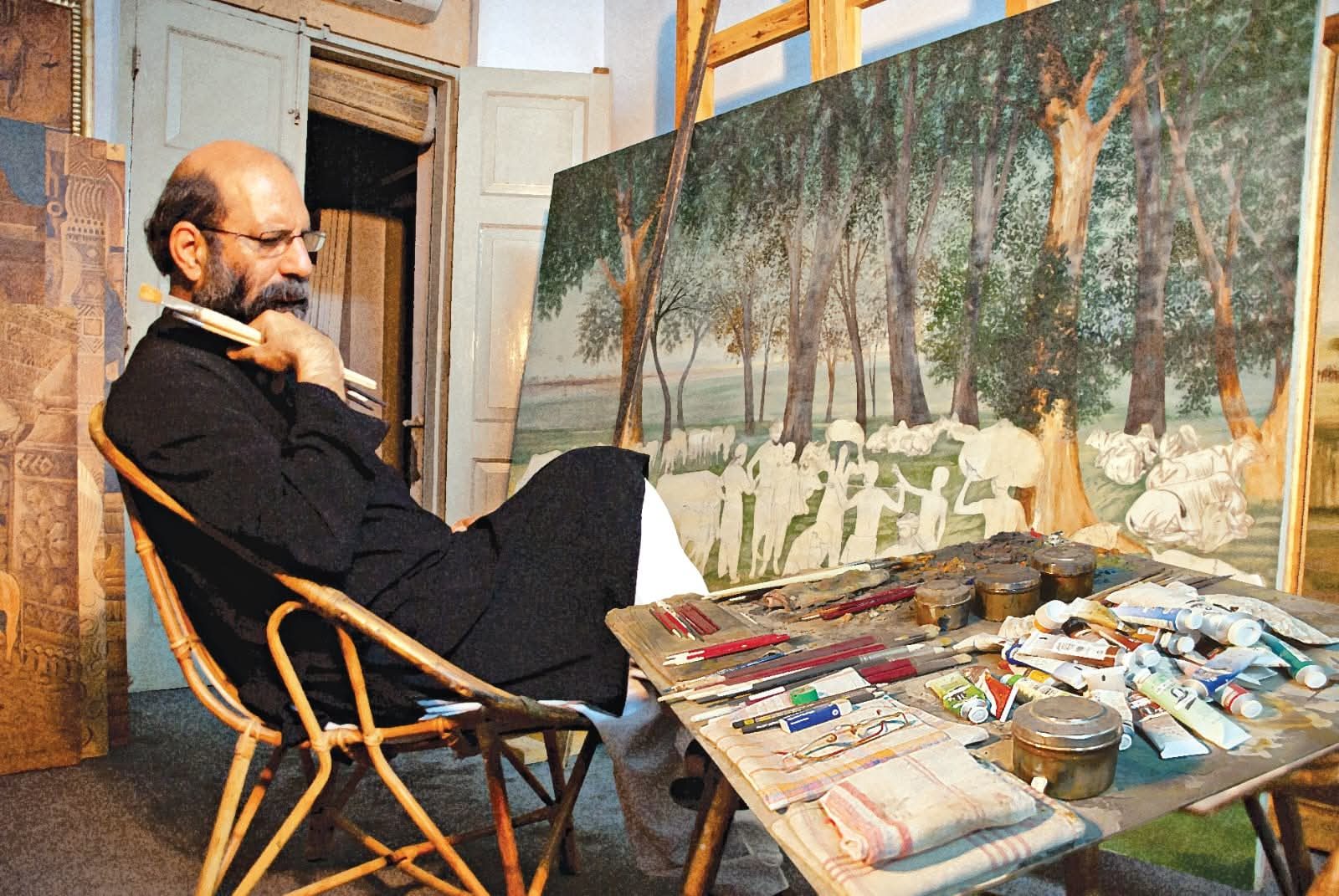
Jimmy Engineer on Art, Struggle & Partition | The Story Behind His Last Train Series | Urdu Podcast
Jimmy Engineer is a legendary Pakistani artist, social crusader, and philanthropist whose iconic Partition Series—including the famous The Last Burning Train—serves as a heartbreaking visual tribute to the unnamed millions who suffered during the 1947 independence migration. Born into a Parsi family in Balochistan, he describes himself purely as a “servant of Pakistan,” bridging communal and religious divides through his profound art and extensive humanitarian work.
The Story Behind the Partition & "Last Train" Series
• Visions from Dreams: Jimmy did not initially intend to paint the Partition. In the 1970s, he began experiencing intense, agonizing nightmares of massacres, burning villages, and train cars filled with victims. Compelled by an inner fire to stop the sleepless nights, he transferred these horrifying visions directly onto massive canvases.
• Honoring the Unnamed: While mainstream history heavily records political leaders, Jimmy’s main focus was paying tribute to the everyday refugees. He designed his vast 10-by-15-foot oil paintings to honor the ordinary men, women, and children who lost their lives without ever getting to see the flag of their new country.
• The Last Burning Train: This specific collection captures the harrowing scenes of mass migration by rail. To achieve physical accuracy, he even ventured into rail yards to sketch and paint abandoned, burnt-out train carriages.
• The End of the Series: Remarkably, once his vivid nightmares stopped, his drive to paint these specific scenes vanished. He stepped away from the topic for 20 years, returning later in 2009 to work on a final, chaotic piece that remained largely abstract, dissolving into a symbolic sea of red.
Artistic Legacy & Humanitarian Journey
Beyond his historical masterpieces, Jimmy Engineer is celebrated for his deep social conscience:
• Prolific Portfolio: He has created over 3,000 original paintings, 1,000 calligraphies, and hundreds of thousands of prints spanning themes from Allama Iqbal's philosophy to Pakistani architecture. His prints are permanently displayed at key historic sites like the Wagah Border (Bab-e-Azadi) and the Punjab Assembly.
• Philanthropy and Activism: Awarded the prestigious Sitara-e-Imtiaz for his service, he has walked over 100 long-distance peace walks and organized more than 140 awareness and support programs for orphaned, blind, and disabled children.
Comments
Comments are read before they appear, so yours will show up once it has been approved.
No comments yet. Be the first to leave one.